
A theoretical walkthrough of the chain from brand perception to actual charitable behaviour
When someone decides to donate to a nonprofit organisation, it rarely happens in a vacuum. There is no clean moment of pure rational deliberation where a person weighs costs against benefits and produces a donation as output. The decision is messier, more layered, and more human than that. It is shaped by what people feel about an organisation, what they believe their peers expect, what they feel morally obligated to do, how much control they think they have over the act of giving – and, crucially, how much they actually trust the organisation they are being asked to support.
This post unpacks a theoretical architecture that tries to make sense of that chain: from the brand a nonprofit projects into the world, through the psychological machinery of intention formation, all the way to the moment of actual donation – or the frustrating gap between intention and behaviour.
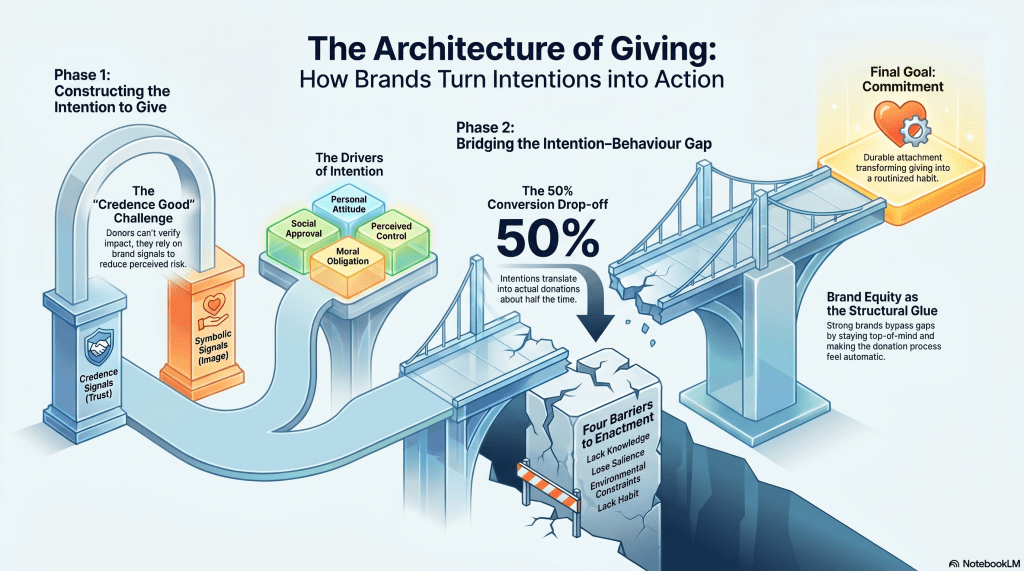
The Problem: Donations Are Credence Goods
Let’s start with a structural challenge that defines the whole problem. When you buy a coffee, you taste it. When you donate to a humanitarian organisation, you usually have no way of verifying what actually happened with your money. Did it reach the right people? Was it used efficiently? Did it make a difference?
Economists call goods like this credence goods – their quality cannot be evaluated even after consumption. This creates a deep asymmetry of information between the donor and the organisation, and it fundamentally shapes how giving decisions are made. Under these conditions, people cannot reason from objective evidence. They reason from signals – and the most powerful signal available to a nonprofit is its brand.
A brand, in this framing, is not just a logo or a colour palette. It is a socially recognised, cognitively accessible reference point that reduces uncertainty — not just for the individual donor, but as a shared convention across an entire donor community. When a donor recognises an organisation, trusts its reputation, and feels attached to its mission, that brand is doing real epistemic work: it is substituting for information the donor cannot otherwise obtain.
Layer One: The Brand as Signalling Architecture
Not all brand signals operate the same way. It helps to distinguish between two functionally different types.
The first type – credence-reducing signals – includes constructs like trust and awareness. These signals lower the perceived risk of giving. If a donor has encountered an organisation repeatedly, it feels familiar and therefore safe. If the organisation has built a reputation for integrity and transparency, it reduces the donor’s fear that their contribution will be wasted or misused. Trust, in particular, is not just a warm feeling – it functions as an uncertainty-reduction mechanism in a domain where donors literally cannot verify outcomes. The warmth comes from reduced fear of uncertainty.
The second type – symbolic differentiation signals – includes brand image and brand personality. These signals do something different: they enable identity-based and affective alignment. A donor who perceives a charity as dynamic, committed, and values-congruent is not just reassured – they feel a personal resonance. They become „part of the team“, as with football-teams or our favorite sneakers. Brand personality (the human-like traits attributed to an organisation) and brand image (the evaluative associations that cluster around it) speak to the self-concept of the donor, to questions of who I am and what I stand for.
Both signal types matter, but for different things. Credence-reducing signals tend to matter more for sustained, recurring support – the kind of relationship where a donor keeps giving because they have come to rely on the organisation’s reliability. Symbolic signals tend to matter more at the entry point, where a potential donor is deciding whether to engage at all.
What holds these signals together into a coherent structure? This is where brand equity enters the picture – not as a simple score or index, but as a processual architecture. Brand equity, in its richer interpretation, develops sequentially: it begins with awareness and recognition, moves through trust and the reduction of perceived risk, and crystallises into commitment – a durable relational attachment that disposes the donor to give again and again. This is not a static asset. It is a dynamic system that shapes how donors think, feel, and ultimately act.
Layer Two: From Brand to Intention
Brand perceptions do not directly produce donations. They work through psychological mechanisms that generate intention. The Theory of Planned Behaviour (TPB) provides the most empirically well-supported account of how this happens.
The TPB posits three belief systems that converge on intention.
Attitude captures the person’s evaluative judgement of the act of giving – whether they think donating is a good thing to do, a worthwhile investment of their resources, or an act aligned with their values. Brand image and personality are the upstream forces shaping this evaluation: an organisation that feels useful, credible, and aligned with the donor’s sense of what matters is one toward which attitude will be positive.
Subjective norms capture the donor’s perception of social approval – whether the people who matter to them think they should give. Brand awareness is closely connected to this pathway: organisations that are widely known are also perceived as socially legitimate giving targets. Familiarity breeds a kind of normative endorsement. If an organisation is well-known and widely supported, giving to it feels like the socially sanctioned thing to do.
Perceived behavioural control captures the person’s sense of whether they are able to give – whether donating feels easy, feasible, and within their reach. This is where trust does some of its most important work. When a donor trusts an organisation, they are not only reassured about outcomes; they also feel more confident about the act of giving itself. The perceived risk of mismanagement or futility is lowered, and with it, the subjective barriers to action.
Beyond these three classical components, prosocial contexts like charitable giving call for a fourth element: moral norms – the internalised sense of personal obligation. Donors do not only ask whether giving is smart or socially expected; they ask whether it is right. This moral dimension adds explanatory power precisely because donation decisions are embedded in evaluations of responsibility, deservingness, and obligation to others.
Brand image and personality tend to shape attitude most directly, while trust works primarily through perceived behavioural control by reducing the perceived risk of futility. Awareness likely activates both normative and attitudinal routes simultaneously. These mappings are not clean one-to-one relationships – most brand signals feed into multiple belief systems at once – which is exactly what makes them interesting to test empirically rather than just assume.
Layer Three: The Intention–Behaviour Gap — Where Good Intentions Evaporate
Here is where the model gets uncomfortable. Across dozens of studies and several meta-analyses, the evidence is consistent: a large share of people who report a clear intention to donate never actually do so. We see the same in blood donation or in health-related intentions like quitting smoking. Meta-analytic estimates suggest that intentions translate into action only about half the time. The road from „I really should give“ to an actual transfer of funds is littered with dropped intentions.
This is not a small rounding error. It is a fundamental structural problem for any theory of giving that treats intention as the final stop. Intentions are necessary but not sufficient. Between wanting to give and actually giving stands a set of enactment conditions – situational, cognitive, and environmental factors that either enable or obstruct the conversion of motivation into behaviour.
The Integrated Behavioural Model (IBM) gives these conditions a name and a structure. Four are particularly relevant in the context of charitable giving:
- Knowledge and skills – Does the person actually know how to donate? Do they know which platform to use, which bank details to enter, which campaign is currently active? Procedural ignorance is a surprisingly effective barrier to giving.
- Salience – Is the cause cognitively present at the right moment? An intention formed in response to a news story may evaporate by the time the person is in a position to act. Organisations that maintain visibility — through campaigns, reminders, or social presence — keep the cause salient and the intention alive.
- Environmental constraints – Are there structural barriers? Financial pressure, time scarcity, complicated donation processes, or competing demands can all prevent an intention from becoming a behaviour, regardless of how sincere that intention was.
- Habit and past behaviour – Repeated giving over time becomes routinised. Habitual donors do not deliberate each time; they act from an automatic disposition. This is both a goal state (cultivating habit) and an explanatory variable: past behaviour is one of the strongest predictors of future behaviour, precisely because it captures this automaticity.
Crucially, brand equity feeds into this layer too. A highly familiar organisation is one the donor knows how to reach – reducing the knowledge barrier. A salient brand is one that stays top of mind – reducing the forgetting problem. A trusted organisation is one whose constraints feel surmountable – because the donor believes the effort is worthwhile. And a brand toward which a donor has genuine commitment tends to generate the kind of habitual engagement that bypasses the intention–behaviour gap almost entirely.
Putting It Together: The Architecture of Giving
The full picture, then, looks something like this.
A nonprofit brand emits signals into the environment – signals of reliability, identity, mission, and quality. These signals are received by potential donors as perceptions: awareness, trust, image, personality, and ultimately commitment. These perceptions do not directly produce behaviour. They first shape the psychological antecedents of intention – the evaluative, normative, control-related, and moral beliefs that the Theory of Planned Behaviour identifies as the proximal drivers of wanting to give. Intention, in turn, is necessary but not sufficient: whether it converts into actual donation depends on the enactment conditions that the Integrated Behavioural Model describes – knowledge, salience, the absence of prohibitive constraints, and the presence of habitual patterns.
At each step in this chain, the brand is present – not as a simple input that produces a simple output, but as a structural force that shapes the entire architecture of the giving decision.
This matters practically. When fundraising efforts underperform, the problem could lie anywhere along this chain. Weak awareness means the brand is not generating consideration at all. Insufficient trust means that attitude and perceived control are depressed even among people who have heard of the organisation. Poor salience means intentions form but evaporate before action. Low procedural familiarity means that motivated donors fail at the final hurdle. Diagnosing which part of the architecture is failing requires a model that is sensitive to all of them – and that treats the brand not as decoration, but as the structural foundation on which the whole behavioural sequence rests.
A Final Note on the Austrian Context
None of this unfolds in a vacuum. The signalling function of nonprofit brands is not context-independent. In Austria, recent years have seen significant reputational turbulence in the nonprofit sector – from public criticism of large organisations to broader political narratives questioning the legitimacy of NGOs. When these disruptions occur, they do not merely affect individual organisations in isolation. They can weaken the signalling infrastructure of the entire sector: eroding trust as a categorical expectation, reducing the normative legitimacy of giving, and amplifying the perceived uncertainty that brand equity is supposed to reduce.
This contextual sensitivity is not a marginal complication. It is a reminder that nonprofit brand equity is not a fixed asset. It is a relational construction, built slowly through consistent behaviour and communication, and capable of being damaged quickly by reputational shocks – whether the organisation itself caused them or merely absorbed them by association.
Understanding this architecture is, among other things, an act of institutional responsibility. If we want to understand why people give – and why they sometimes do not, despite every good intention – we need to take seriously the full chain from brand signal to enacted donation. That chain is longer, more conditional, and more contextually embedded than any single-variable model can capture.
This post draws on the theoretical framework developed in a current research for my dissertation examining nonprofit brand equity and donation behaviour in Austria, using structural equation modelling across multiple competing model specifications.
 Diss-Tance